Etter at desse folka var i Canada, har folketalet i bygda auka med 50 prosent
The following is an English translation of the original article from Hallingdølen, Published: Sunday, February 13, 2022 at 04:10
After these people went to Canada, the village’s population has grown by 50 percent
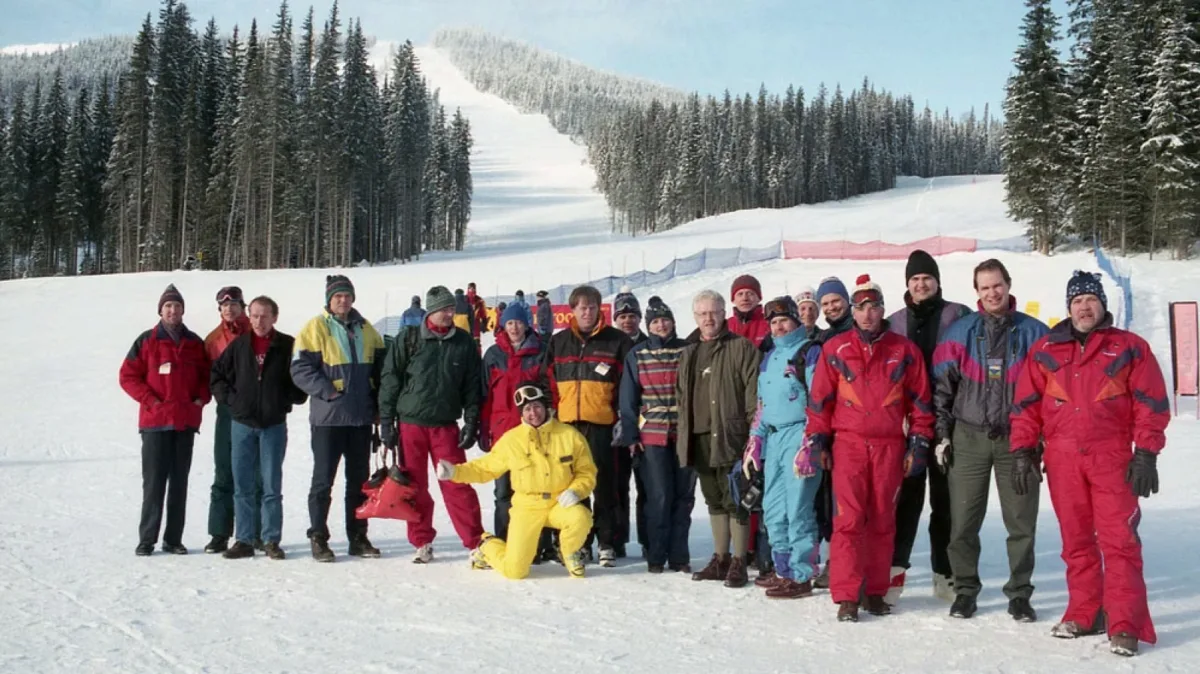
From January 20–26, 1997, Hallingdølen followed a 16‑person Hemsedal delegation on their study trip to the ski resorts Sun Peaks and Whistler.
Image caption:
The Hemsedal delegation gathered in Sun Peaks. From left: Jon Thorset, Espen Eliassen, Bjørn Svare, Åge H. Haga, Martin Lindal, Ragnhild Halbjørhus, Sverre Kirkebøen, Kåre Grøthe, Ragnhild Kvernberg, Bjørn T. Moger, Morten Brunvoll, Ivar Bergstøl, Norvald Lirhus, Odd Holde, two local representatives in Whistler/Sun Peaks, and Ernst Tore Eggen. Here with Nancy Greene, Olympic giant slalom champion from Grenoble 1968.
Photo: Olav Johannes Bøthun
Olav Johannes Bøthun
Updated: Sunday, February 13, 2022 at 04:10
(This article is more than four years old.)
The decision by members of this group to focus on commercial lodging when the municipality and the tourism industry planned the mountain village may have been the key to Hemsedal’s strong population growth.
Whistler is a massive ski metropolis not far from Vancouver. Sun Peaks lies six hours inland by car and, at the time, was almost as much in development as Hemsedal. The consulting firm Ecosign hosted the study trip, and the same company was appointed to provide professional input for Hemsedal’s planning work.
“The trip gave us many impressions, but few answers,” was the conclusion for many. Twenty‑five years later, we ask the follow‑up question: Did things turn out the way you expected?
Background: The Important Trip
The delegation included representatives from Hemsedal municipality, the tourist office, landowners, and the board and administration of Hemsedal Ski Center. In Whistler and Sun Peaks they observed how Ecosign had planned enormous ski metropolises—similar to what was envisioned for Hemsedal. The hallmark of these plans was concentrated development in compact, walkable villages located next to the ski area. The centers would be car‑free, with short distances between shops, restaurants, hotels, and apartments. Most beds were intended to be “warm beds,” meaning commercial lodging available for rent.
Image caption:
Whistler 1997: A tourist slides into the photo. Notice the construction crane on the right—similar cranes are numerous in Hemsedal today.
Photo: Olav Johannes Bøthun
Another image shows Jon Thorset examining the latest Ecosign sketches for the Trøim–Holdebakken area.
Hemsedal Today
Twenty‑five years later, the development on the other side of the Atlantic—in Hemsedal—is booming. Hotels, holiday apartments, and private cabins are appearing densely across Holdebakken.
Several questions arise:
- Has Hemsedal achieved what the delegation imagined 25 years ago?
- Has the development gone completely off track?
- Or is what we see today exactly “according to plan”?
“Completely by chance, really”
Odd Holde, who played a central role in Hemsedal Ski Center and local politics, recalls how the collaboration with Ecosign began:
“It was by chance we ended up with Ecosign. I was visiting Doppelmayr in Austria, was invited to a dinner, and ended up at the same table as Peter Alder from Ecosign. That’s where it started.”
He explains that the planning took four–five years and was mostly completed by 2001. The plan was adopted in 2003.
Holde recalls discussing with Ecosign’s Paul Mathews how long it would take to execute the plan. Their estimate—20 years—turned out to be remarkably accurate.
Holde is very satisfied:
“The most important thing is that we connected with Ecosign. It was a stroke of luck for Hemsedal. We achieved a long‑term plan where everything fit together. Previously, development was fragmented. This plan covered the whole ski area and base area. And it has been followed meticulously.”
He also emphasizes the importance of maintaining a high proportion of rental beds, noting the village’s 70/30 split between commercial lodging and private units.
Further Reflections from Delegation Members
Ragnhild Kvernberg
She notes that the core principles of the plan are visible today, though development has gone beyond Holdebakken toward the town center. She believes too little has been done on lifts and slopes and wants more rental units to avoid weekend crowding.
Martin Lindal
He supports Kvernberg’s concerns and warns against too many private cabins.
Sverre Kirkebøen
As a landowner and developer, he says the delegation learned the importance of concentrated development. He believes Hemsedal still has “significant potential.”
Ernst Tore Eggen
He credits the turning point to the entry of Swedish operator Skistar but stresses the need for more ski area infrastructure to match growing bed capacity.
Espen Eliassen
Former tourism chief, now harbor master in Horten, praises the strict rental requirements and calls them crucial for sustainability.
Additional comments from other participants reflect a mix of satisfaction, concern over environmental impacts, and recognition that much of what was envisioned has indeed come to pass—sometimes faster and more extensively than expected.